Chapter 4

AI and the future of email

While it’s true that AI offers a lot of promise for conversational customer experiences through other channels, it’s also shaping the future of email in significant ways.

Throughout this chapter, we’ll find out how senders are using AI to optimize and enhance their email programs. Plus, where are organizations investing in email in the age of AI?
Image for AI and the future of email

Key findings on AI and email

In 2026, it’s nearly impossible to talk about the future of anything without artificial intelligence entering the conversation.

Last year, Sinch research revealed 98% of businesses were using or planned to us AI in customer communications. But if your mind goes straight to AI-powered chatbots, you may be missing the bigger picture.

While it’s true that AI offers a lot of promise for conversational customer experiences through other channels, it’s also shaping the future of email in significant ways.

Throughout this chapter, we’ll find out how senders are using AI to optimize and enhance their email programs. Plus, where are organizations investing in email in the age of AI? 

While AI tools are somewhat more common among high-volume senders, most businesses are finding ways to use artificial intelligence as part of their processes. Close to half of those surveyed believe AI tools have made their email programs faster and more efficient.

Here are some big-picture takeaways from what more than 1,200 email senders say about AI and email:   

79%

of senders are using or plan to us AI as part of their company’s email program.

27%

of senders say AI tools are regularly used as part of their email program

46%

of those using AI with email say it has helped increase speed and efficiency.

21%

of senders claim they have no plans to use AI tools in connection with email communications.

41%

say AI helps them generate email copy, making it the most common use case.

23%

say AI has not helped them improve their email programs.

Many email teams (41%) say they are using AI to help generate copy. While that’s certainly not a bad idea, it may not be where AI can have the biggest impact on your email program. Let’s explore the insights on AI-powered email strategies and what’s on the horizon for this communication channel. 

Using AI in email communications

It’s nearly an 80/20 split between senders who see the possibilities of AI and email and those who don’t. A combined 79% are using or plan to use AI in their email programs while 21% say they do not expect to use AI.

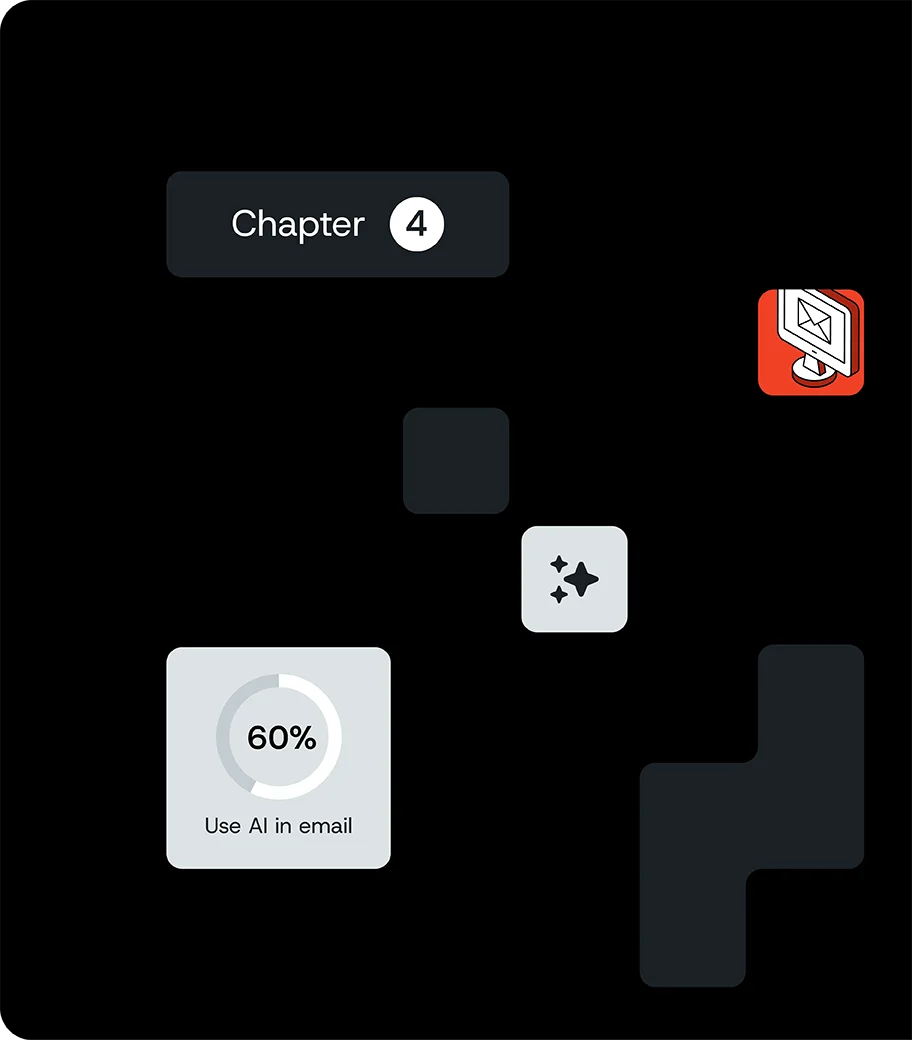
A combined 60% of senders are already using AI tools with email at least some of the time, including 27% who say AI is used regularly.

For the 1 in 5 senders who say they don’t plan to use AI, that stance may be hard to maintain. AI-driven capabilities are increasingly being embedded directly into email platforms.

In fact, AI may already be working behind the scenes, powering features like send-time optimization or engagement modeling. This can be true even if senders don’t think of their programs as “AI-driven.”

High-volume senders, those deploying more than 100K emails per month, are more likely to have adopted AI tools for email. Sinch Mailgun’s research found nearly three quarters (74%) report that they’re using AI within their email programs at least some of the time (compared to 60% of all senders). 35% of high-volume senders use AI tools regularly.

Senders with higher volumes may also have more advanced programs and priorities as well as larger contact lists to manage and more data to process and analyze. 

How are senders taking advantage of AI?

One of the most common uses for generative AI is writing assistance. Our research shows this is also typical among email senders.

Among those using or planning to use AI, more than 40% say it helps with generating email copy followed by 37% who use it for a related purpose – subject line optimization.

Generating email code, templates, and graphics with AI is also fairly common.

Some use AI help to make emails more relevant. 36% use or plan to use AI to personalize email content, and 29% have AI generate of dynamic email content. This could include real-time updates on shipping, inventory, platform analytics, or any information that changes.

Send time optimization (27%) also makes the inbox experience more relevant, delivering messages when individual contacts are most likely to engage.

At least a quarter of senders in our survey are leaning on AI to help them process and understand data from their email programs: 

  • 27% use AI to access/analyze email data
  • 24% use AI in connection with predictive analytics
  • 22% use AI for A/B testing assistance
  • 21% use AI to help with list segmentation

What’s the advantage of using AI in email?

The main expectation for AI in many businesses is making repeatable processes faster and more efficient. Doing more with less is obviously an ideal way to boost the bottom line.

That tracks to the biggest advantage in our survey of email senders too. 46% of respondents say AI helps them increase speed and efficiency in their email programs.

When asked to select all the advantages of AI for email, 43% also chose improved creativity while 38% say AI contributes to reduced workload.

A less common perceived advantage of AI includes 11% who say it helps them understand subscribers. That may have less to do with AI’s capabilities and more to do with the way it’s being used.

21% report that AI is having a positive impact on overall email program performance. Yet, around the same percentage (23%) think it hasn’t helped at all. Only 13% say AI use is boosting email engagement. 

For organizations prioritizing speed and efficiency through AI, an effective way to do that is making email tools easier to use and faster for your teams to learn. That’s why Sinch Mailgun introduced a Virtual Email Assistant in 2025. It’s designed to guide Mailgun Send users through onboarding and beyond, helping with everything from API integration to answering technical, email-related questions. Mailgun’s Virtual Email Assistant is built on Sinch Chatlayer. 

How will agentic AI impact email communication?

At this point, many of the ways your company takes advantage of AI likely involve telling it what to do. Someone enters a prompt and the AI generates a response or completes a task. But the future of AI and email is agentic, and the future is already here.

An AI agent acts autonomously on behalf of your company and your customers. Rather than always waiting for a prompt, agentic AI tools often work proactively behind the scenes. Agentic AI can manage entire email workflows end to end. That includes deciding when to send, who to send to, what content to use, and when to stop or adjust.

Here are just a few ways agentic AI will be applied to email programs.

1. Advanced personalization at scale

Instead of basic merge tags or fixed segments, agentic AI can dynamically assemble emails for each recipient, using machine learning to guide its autonomous decisions. Over time, the system learns what works best for each individual and adjusts automatically.

2. Proactive deliverability management

An AI agent focused on deliverability could monitor sending patterns, engagement trends, and list health, then take action before problems escalate. For example, it could slow sends to risky segments, suppress disengaged contacts, or recommend changes that protect sender reputation and compliance.

3. Continuous testing and improvements

Instead of marketers defining A/B tests one by one, agentic AI can run continuous experimentation. It can test variations, interpret results, and roll winners forward without waiting for human input. This makes optimization an ongoing process rather than a periodic exercise. 
Agentic AI can also help provide a more cohesive customer experience as it has the power to connect different communication channels. An AI agent in a CPaaS could decide when email is the right channel and when another channel should take over. For example, it might pause email for an unresponsive contact and trigger a follow-up via SMS or another messaging channel.

What’s in your company’s email toolbox?

Every carpenter has their favorite tools. But once you start using a nail gun, you’ll think twice about picking up your trusty, rusty hammer the next time there’s a big job to be done fast and efficiently. The point is – some tools have a bigger impact on results than others.

Sinch Mailgun asked survey participants to rate the impact specific email tools and tactics have on the success of their email programs. The most impactful tools included those that support design and content, personalization, automation, and contact list management. 

45%

rate design and copywriting as having a high impact on success

43%

rate the impact of email automation tools on success as high

42%

say email personalization tools have a high impact on program success

41%

of senders rate the impact of email address validation tools as high

36%

say email quality assurance (QA) testing has a high impact on success

24%

believe A/B testing has a high impact on email program success

Are email programs improving?

An effective way to understand and plan for the future is to look back at how far you’ve come. So, we asked senders to tell us how their email programs fared in 2025.

While 39% believed performance, revenue, and email ROI were about the same year over year, a combined 49% say overall results from email improved moderately or significantly in 2025.

Just under 13% say the results from their email programs decreased last year.

But what happens if we compare the senders using AI to those who’ve yet to adopt it or don’t plan to. 

The potential impact of AI on email programs

There’s a noticeable difference in perceived success when comparing those who’ve implemented AI into their email programs versus those who have not. 54% of senders using AI say email programs improved in 2025. That’s 15-percentage points higher than the overall average. Senders who aren’t using AI were slightly less likely than average to see email program improvements.

Those who aren’t using AI, were also more likely to have stagnant email programs. 52% of those senders report their email program success remained about the same in 2025. 

54%

of senders who’ve implemented AI say their email programs improved moderately or significantly year over year.

37%

of senders who are not using AI saw email program improvements in the same time period

Deciding to forgo the efficiencies and other advantages of generative AI for copy and image creation is a valid and defensible ethical, workplace, and brand position. As AI slop spreads across the internet, there’s a growing movement around “100% human-created” content. Some brands will want to be a part of that for a variety of reasons. What’s much less defensible is refusing to use AI for predictive analytics, data analysis, segmentation, send time optimization, and other functions that:

– Are behind the scenes
– Perform tasks that humans simply can’t do at scale
– Don’t impact brand voice, image, and stewardship

There are many different kinds of AI and many different use cases. While some brands will strive for maximal usage of the full spectrum of options, many brands will be selective about their AI usage and that’s okay. But an across-the-board prohibition seems utterly counterproductive for brands that want to create outstanding subscriber experiences.
Chad S. White GVP of CRM Strategy at Zeta

Investing in the future of email

It makes no difference if it’s artificial intelligence, improved deliverability, personalization, automation, or any other factor that could enhance the email channel. There will be investments of time and money if you choose to pursue them. So, do senders have the budget to prioritize email?

We asked survey participants about their plans for investing in email communications in 2026. Just under half (48%) plan to keep email program budgets unchanged. But 31% say they will increase their investment in email this year.

Just under 15% of senders were unsure what their 2026 email investment would be at the time we asked, but only 7% reported plans to decrease their investments in email.

This suggests that at least a combined 79% of organizations depend on the value that email provides. They’ll continue investing in the channel as a foundation of their customer communication strategies.

Opportunities to improve and invest

Whether your business is putting more money behind the email channel or not, the goal is always to improve results and boost the channel’s performance.

We asked senders to select up to three areas they believed to be the biggest opportunities for email program improvement in 2026.

There was a tie for the top spot. 40% of senders selected increasing email engagement as a key area of improvement, and the same percentage chose the opportunity to take advantage of AI.

Around one third of respondents believe focusing on factors including improved personalization, automation, and better email content represent areas of opportunity.

Least likely to be chosen were focusing on email accessibility and investing in better email tools. Around 20% of senders see these as opportunities for improvement. 

Many of the ways you can improve email accessibility are easy to accomplish, and there’s no reason to ignore them. Not only will they make it easier for people with disabilities to engage with your emails, but they also make the inbox experience better for all of your customers and subscribers.

“As we are transcending more and more into a digital world, the importance of this accessibility act is becoming even more relevant. Many users are opting to use online sites and applications instead of the physical domain. A great example is in the banking industry where over 70% of all bankers are using digital banking applications instead of in-bank experiences. So now more than ever, people with disabilities need to have guaranteed access to this digital world.”
Photo of Darine Fayed
Darine Fayed VP General Council EMEA, Sinch

Trust Sinch Mailgun to put you on the path to better deliverability

In addition to our industry-leading email delivery platform, Mailgun Send, you can also find solutions built to help your organization demystify deliverability, reach more inboxes, and maximize your investment in the email channel.

Improve inbox placement 
 
Mailgun Optimize is our complete deliverability suite.  
 
Get a collection of tools designed to help your email program scale with simplicity. 
 
That includes inbox placement tests, validations, reputation monitoring, and many other features built to optimize every email you send. 

See Pricing
Validate every contact 
 
Mailgun Validate helps you focus on list hygiene and reduce waste. 
 
Stop sending emails to addresses that don’t exist. Use this tool to verify new subscribers or clean up your existing contact database. 
 
Validate does much more than catch typos in email addresses. It even keeps bots from abusing your forms. 

Talk to an Expert
Conduct email QA 
 
Mailgun Inspect lets email teams conduct quality assurance to gain confidence before hitting send. 
 
Take advantage of email previews on 100+ devices and clients. Plus, use the accessibility checker to boost email engagement. 
 
Inspect includes many other QA tests that ensure every email is flawless. 

Find Out More
Deliverability: The impact of inbox placement Chapter 3 Deliverability: The impact of inbox placement Conclusion: Is email working for your organization? Chapter 5 Conclusion: Is email working for your organization?