MailerLite alternatives: The best tools for email marketing and transactional messaging
MailerLite is a go-to for small teams looking for simple, affordable email marketing and automation. Its intuitive drag-and-drop editor and templates make setup fast and easy. But as businesses scale, some outgrow MailerLite's simplicity, seeking more advanced automation, transactional email, or budget flexibility.
Some teams consider switching for additional analytics, deliverability controls, or transactional email support. If you’re ready to explore new email platforms, this guide is for you.
How we chose the best MailerLite alternatives
We evaluated each alternative for reliability, feature set, scalability, and ease of migration. Our research focused on the needs of growing businesses and technical, compliance, or budget-sensitive teams.
Deliverability and platform reliability
Pricing structure, scalability, and free tiers
API access, integrations, and automation depth
Data residency, compliance, and support
The top MailerLite alternatives for 2026
Whether you need marketing automation, developer-grade APIs, multi-channel messaging, or a budget-friendly platform, these MailerLite alternatives solve the most common user pain points.
Mailgun
Mailgun is a developer-first platform built for transactional email, robust APIs, and detailed event logging. Unlike MailerLite’s marketer-centric approach, Mailgun is designed for technical teams who prioritize deliverability, customization, and regional compliance.
Best for: Engineering and product teams, SaaS, and high-volume senders needing reliable transactional email with granular logging and regional data processing.
Scalable usage-based pricing with monthly minimums
Features:
Developer-centric RESTful API and SMTP relay
Up to 30-day searchable logs on paid plans and real-time webhooks
Regional data processing (US/EU) and data residency
Optional dedicated IPs and IP pools available on higher tiers
Email validation and deliverability tools
SSO and advanced security on higher plans
Pros:
Superior event logging and debugging tools
Flexible, transparent pay-as-you-go pricing
Compliance-ready with regional data options
Cons:
No drag-and-drop campaign builder
Steeper learning curve for non-technical users
Marketing automation not included; requires third-party tools
ActiveCampaign
ActiveCampaign merges advanced marketing automation, integrated CRM, and multi-channel messaging. Its visual journey builder and segmentation surpass MailerLite’s automation, with transactional email supported via third-party integrations (e.g., Postmark).
Best for: Teams needing enterprise-grade automation, CRM features, and multi-channel marketing with data residency.
Pricing overview:
Contact-based pricing; no free tier
Dedicated IPs available as add-ons
Features:
Visual automation builder and deep segmentation
Integrated CRM and sales pipelines
Native SMS and web push (add-on)
Postmark integration for transactional email
Regional data centers (US, EU, APAC)
Migration assistance included
Pros:
Leading automation and segmentation
Strong CRM and sales pipeline tools
Flexible hosting regions for compliance
Cons:
Pricing increases with list size
Transactional email requires separate Postmark account
SMS may need additional compliance steps
Brevo (formerly Sendinblue)
Brevo offers campaigns, transactional email (SMTP/API), SMS, WhatsApp, and chat in one EU-hosted platform. Unlike MailerLite, Brevo unifies marketing and transactional email under one dashboard, ideal for GDPR-conscious teams.
Best for: SMBs to mid-market companies seeking multi-channel messaging with EU data residency.
Pricing overview:
Free and entry-level paid tiers; volume-based pricing
Dedicated IP add-on for higher plans
Features:
Email campaigns and transactional email in one UI
SMS, WhatsApp, and live chat options
EU-only data hosting (by default)
Event webhooks and detailed logging
Drag-and-drop builders for all messaging
Subaccounts and dedicated IPs on Pro/Enterprise
Pros:
Unified marketing, transactional, and SMS/WhatsApp/chat
GDPR-ready with EU data residency
Simple pricing and onboarding
Cons:
Automation less advanced than specialist tools
Dedicated IPs only on higher plans
No multi-region hosting (EU-only)
Omnisend
Omnisend caters to ecommerce, delivering email, SMS, and web push automation. Prebuilt flows and deep Shopify/BigCommerce integration offer more out-of-the-box value than MailerLite’s basic automation. Transactional order notifications run natively, no extra API needed.
Best for: Ecommerce brands needing fast multi-channel automations and shop integrations.
Pricing overview:
Free plan; paid tiers scale by contacts, unlimited emails on Pro
SMS credits included in plan fee
Features:
Prebuilt ecommerce automations and templates
Shopify, BigCommerce, WooCommerce integration
Unified dashboard for email, SMS, and push
Guided migrations and onboarding available
Optional dedicated IP for high-volume senders
Native ecommerce transactional-style notifications (orders, shipping, etc.); not general transactional API
Pros:
Fast setup for ecommerce automations
Multi-channel messaging in one dashboard
Migration services for qualified accounts
Cons:
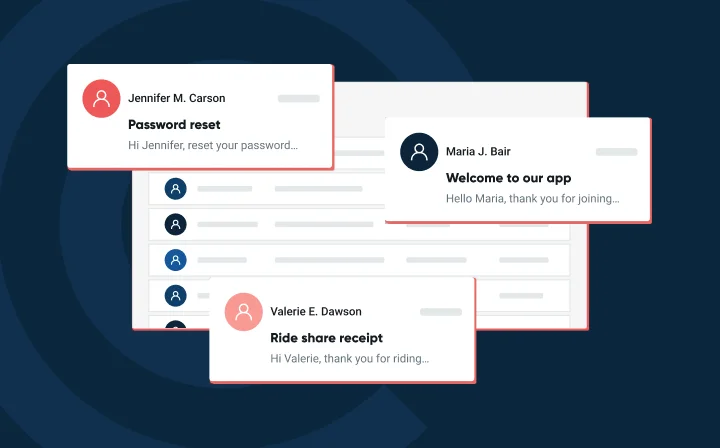
Not built for developer-grade transactional APIs. For example, not suitable for system-triggered transactional messages like password resets
Dedicated IP only for very high volumes
Less granular event logging than Mailgun
Moosend
Moosend delivers cost-effective email marketing and automation with EU-only storage. Basic transactional email available via SMTP, making it a viable MailerLite replacement for teams wanting marketing and transactional sends in one place.
Best for: Budget-conscious EU-based teams needing simple automation and GDPR-compliant storage.
Pricing overview:
30-day free trial; affordable Pro/Enterprise by contacts
Email credit bundles for seasonal senders
Features:
Drag-and-drop campaign builder and automation
Optional transactional SMTP for notifications/receipts
EU-based data centers, ISO-27001 certified
Dedicated IP and deliverability guidance
Flexible credits or subscription plans
GDPR compliance
Pros:
Strong value for EU compliance
Simple onboarding and email templates
Flexible credits model for occasional senders
Cons:
No perpetual free tier
Transactional and dedicated IPs require higher plans
Fewer native integrations
Sender
Sender offers affordable email and SMS automation with a generous free plan. While mainly for marketing, it supports API and SMTP for basic transactional sends; advanced transactional features limited. 24/7 chat support and easy migration make it a practical MailerLite alternative for small businesses.
Best for: SMBs and startups needing basic automation, lots of free sends, and responsive support.
Paid plans scale by audience size; dedicated IPs on higher tiers
Features:
Drag-and-drop email builder and automation
SMS marketing and transactional via API/SMTP
API/webhooks for custom workflows
24/7 live chat support
Free migration assistance
Generous free tier
Pros:
Generous free usage
Responsive support even on low-cost plans
Dedicated IPs available on higher tiers
Cons:
Possible send delays during peak usage
Fewer advanced automations and workflows
Deliverability may vary, test before scaling
How to move from MailerLite to a new platform
Migrating from MailerLite is straightforward if you follow a structured process. At Mailgun, for example, we help you onboard your business and your customers. Use these general steps to transfer contacts, templates, and authentication with minimal risk.
Step 1: Export your data
Export subscriber lists, segments, and campaign history as CSV/XLSX. Download custom fields, suppression lists, and engagement metrics.
Step 2: Set up domains and authentication
Add and verify sending domains in your new platform. Configure SPF, DKIM, and (if needed) DMARC via DNS. Request and configure dedicated IPs if required.
Step 3: Migrate templates and contacts
Rebuild templates with your new editor or import HTML where supported. Import contacts, segments, and custom fields while confirming opt-in status.
Step 4: Test and validate deliverability
Send test emails to check inbox placement and rendering. Monitor bounces, spam complaints, and logs. For transactional email, test API or SMTP integration in staging.
Step 5: Finalize DNS authentication and switch application credentials
Update DNS for domain authentication. Point your app or website to the new SMTP/API endpoints. Monitor live sends closely and keep MailerLite as a fallback until confident to discontinue use.
FAQs
The right alternative depends on your needs. Mailgun is best for transactional APIs and developer control. ActiveCampaign is best for advanced automation and CRM. Brevo is best for unified EU-hosted messaging, and Omnisend is best for ecommerce-focused automation.
Sender offers the most generous free plan, making it the lowest-cost option for small businesses. Moosend is also budget-friendly, especially for EU-based teams. Mailgun scales alongside your business and allows you to send up to 100 emails/day free, with tiered plans to meet your where you’re at.
Mailgun is the top choice for developer-grade transactional email, offering advanced logging, webhooks, and regional data processing for compliance.
MailerLite uses its sister product, MailerSend, for transactional email. Some users prefer a platform like Brevo or Mailgun, where marketing and transactional email are unified.
Sender and Brevo are excellent for SMBs due to their easy onboarding and free tiers. Omnisend is ideal for ecommerce stores needing fast automations.
Re-authenticate your domains (SPF, DKIM, DMARC), warm dedicated IPs gradually, keep your lists clean, and monitor engagement and bounce rates closely during the transition.
Brevo (EU-only by default), Mailgun (US/EU data centers), and Moosend (EU-only storage) all provide options for EU data residency and GDPR compliance.
This guide was created by the team at Mailgun by Sinch. While we’ve aimed for a fair comparison of popular email services, our goal is to show you where Mailgun shines. We hope this helps you make the right choice for your needs. Last updated December 2025.
Most people would agree cookies make life better. For us, they help us make our site and marketing better. But if you don’t like cookies, that’s cool – you can let us know by clicking the settings button!
Your Cookie Choices
When you visit any web site, it may store or retrieve information on your browser, mostly in the form of cookies. This information might be about you, your preferences or your device and is mostly used to make the site work as you expect it to. The information does not usually directly identify you, but it can give you a more personalised web experience. Because we respect your right to privacy, you can choose not to allow some types of cookies. Click on the different category headings to find out more and change our default settings. However, blocking some types of cookies may impact your experience of the site and the services we are able to offer. Cookie Statement
These cookies are necessary for the website to function and cannot be switched off in our systems. They are usually only set in response to actions made by you which amount to a request for services, such as setting your privacy preferences, logging in or filling in forms. You can set your browser to block or alert you about these cookies, but some parts of the site will not then work. These cookies do not store any personally identifiable information.
Cookie details
These cookies allow us to count visits and traffic sources so we can measure and improve the performance of our site. They help us to know which pages are the most and least popular and see how visitors move around the site. All information these cookies collect is aggregated and therefore anonymous. If you do not allow these cookies we will not know when you have visited our site, and will not be able to monitor its performance.
Cookie details
These cookies enable the website to provide enhanced functionality and personalisation. They may be set by us or by third party providers whose services we have added to our pages. If you do not allow these cookies then some or all of these services may not function properly.
Cookie details
These cookies may be set through our site by our advertising partners. They may be used by those companies to build a profile of your interests and show you relevant adverts on other sites. They do not store directly personal information, but are based on uniquely identifying your browser and internet device. If you do not allow these cookies, you will experience less targeted advertising.
Cookie details
These cookies are set by a range of social media services that we have added to the site to enable you to share our content with your friends and networks. They are capable of tracking your browser across other sites and building up a profile of your interests. This may impact the content and messages you see on other websites you visit. If you do not allow these cookies you may not be able to use or see these sharing tools.
Cookie details

 Renate Burns